A blueprint is a document you write once — a proposal, an order form, a business case, a deal room — with blanks where the customer-specific parts go. When someone on your team asks Garba for one, Garba fills those blanks from your deal, company and meeting data, writes the parts that need judgement, and hands back a finished document.
There are two formats: document blueprints, which come out as a report you can export to PDF or Word, and site blueprints, which come out as a web page you can share as a link.
webBlueprints are set up by admins. A blueprint is available to everyone in the account unless you limit it to particular teams. You do not need to write HTML or know anything about merge fields — you describe the document in a chat and Garba builds it.
Go to Settings → Configuration → Blueprints.
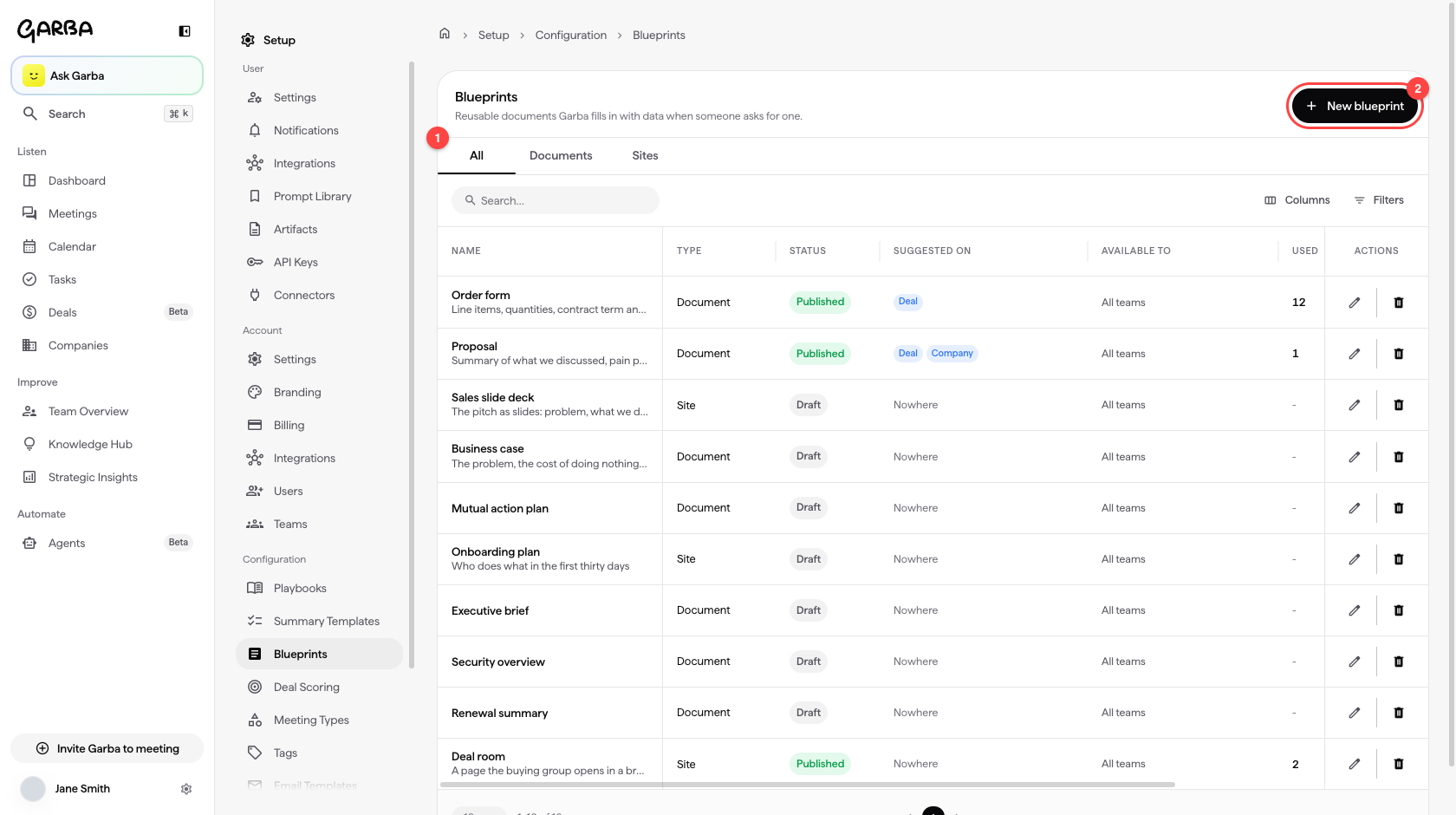
All, Documents and Sites — the tabs split the list by format.
New blueprint — start a new one.
The list shows each blueprint's type, whether it is a Draft or Published, which pages it is suggested on, which teams have it, how many documents have been made from it, who created it and when it was last edited.
Creating a blueprint takes three short steps. The first is the format.
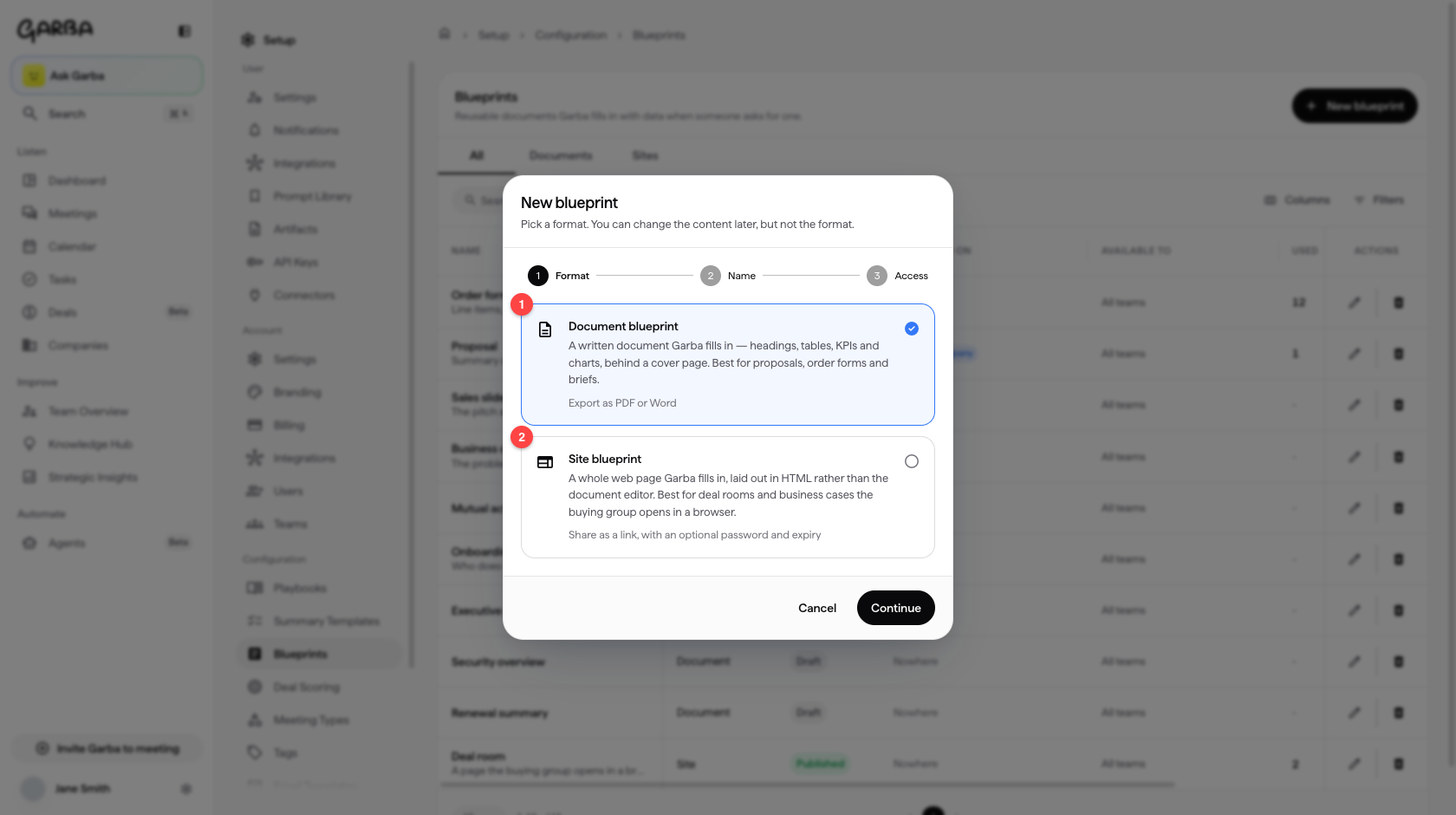
Document blueprint — a written document: headings, tables, KPIs and charts, behind a cover page. Best for proposals, order forms and briefs. Exports as PDF or Word.
Site blueprint — a whole web page, laid out in HTML rather than the document editor. Best for deal rooms and business cases the buying group opens in a browser. Shared as a link, with an optional password and expiry.
Pick the format carefully: you can change the content of a blueprint whenever you like, but not its format.
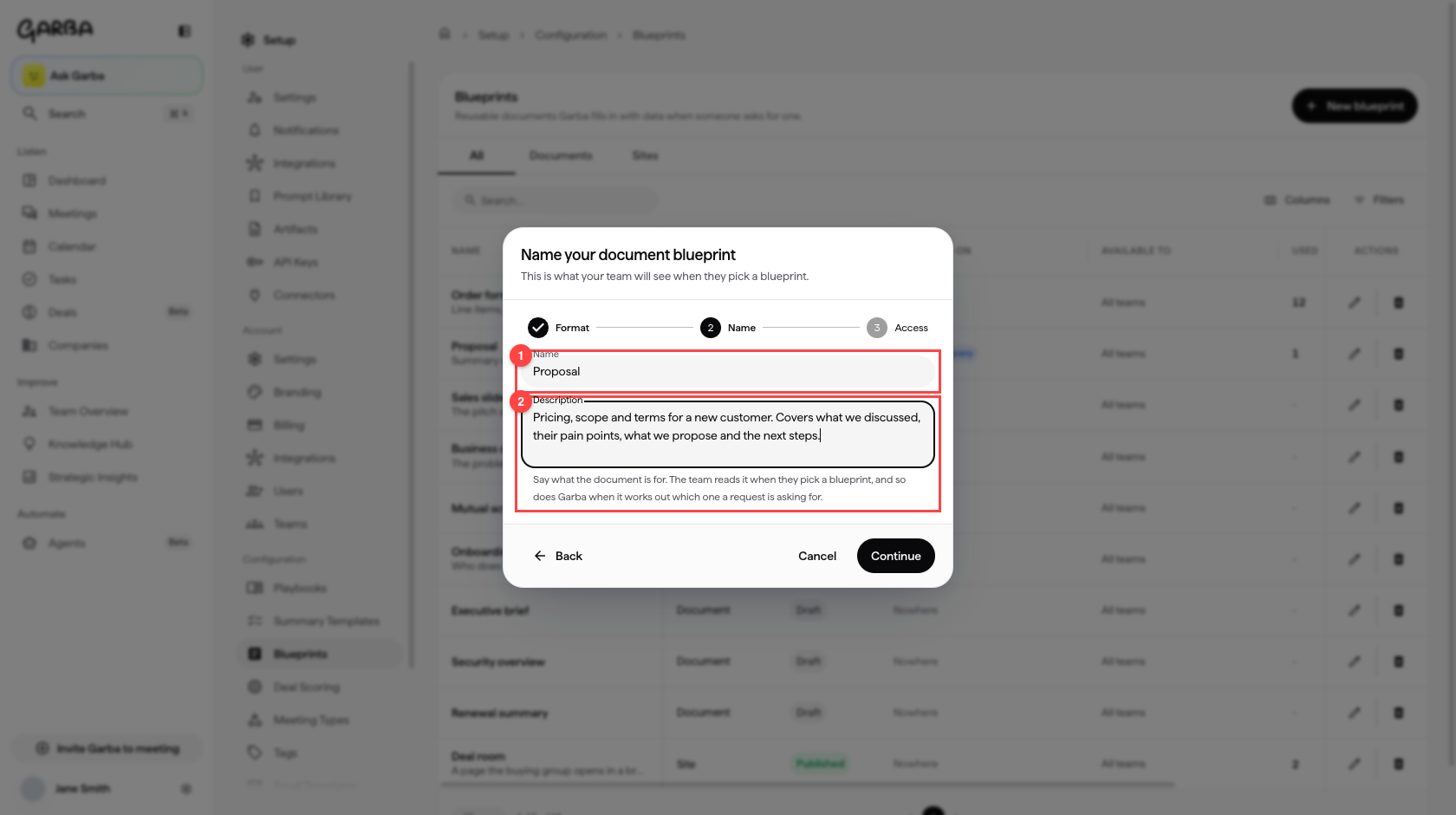
Name — what your team sees when they pick a blueprint. Keep it short: Proposal, Order form, Deal room.
Description — what the document is for. Your team reads it when they pick a blueprint, and so does Garba when it works out which one someone means by "a proposal for Acme". Write it for a colleague who has never seen the blueprint.
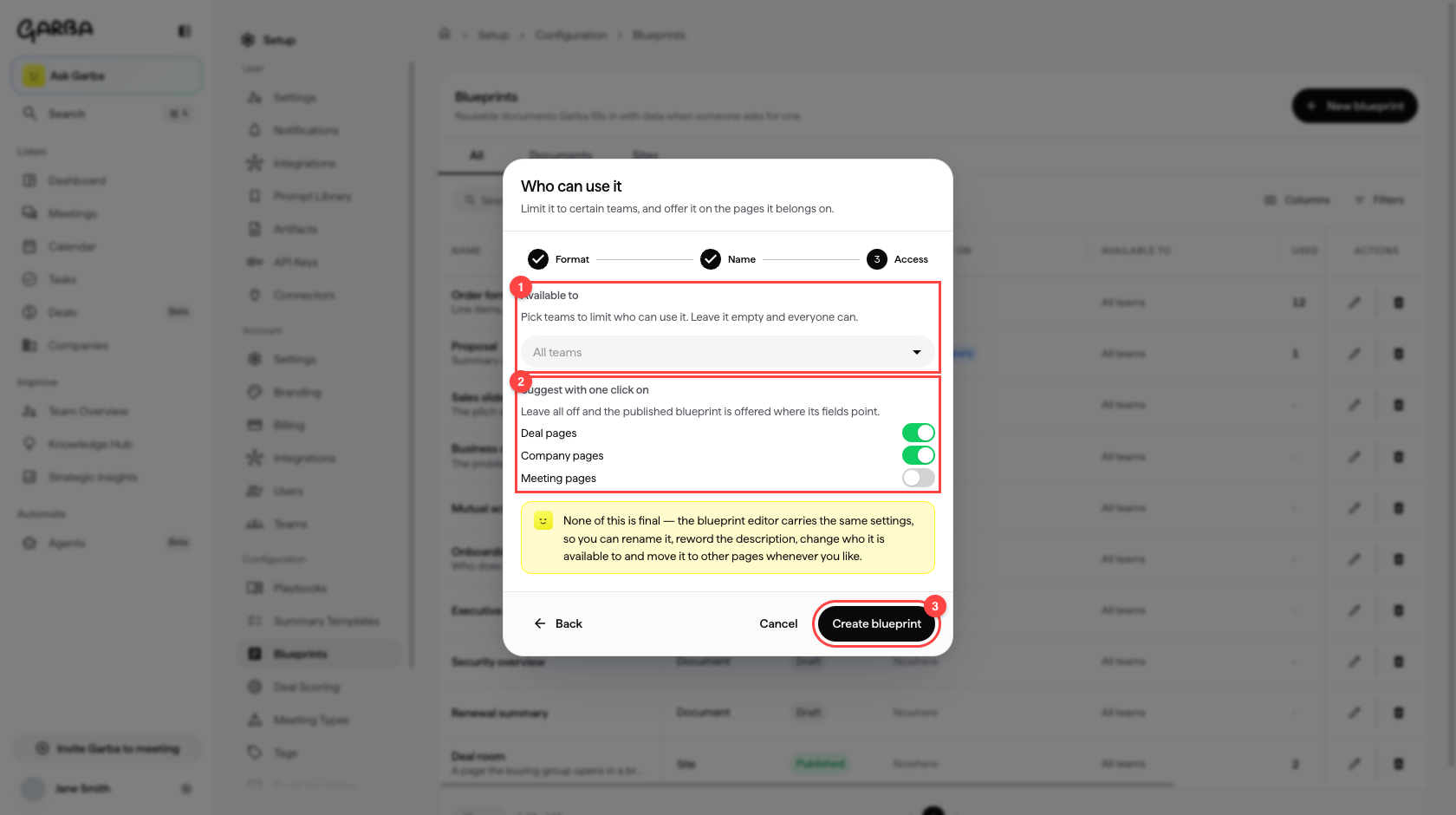
Available to — the teams that can use this blueprint. Leave it empty and everyone in the account can. Useful when Sales and Customer Success each have their own version of the same document.
Suggest with one click on — the pages where the published blueprint shows up as a one-click tile: deal pages, company pages, meeting pages. Leave all three off and Garba offers it where its fields point, so a blueprint built on deal fields is offered on deal pages.
Create blueprint — finishes the dialog and opens the builder.
None of this is final. The blueprint editor carries the same settings, so you can rename it, reword the description, change who it is available to and move it to other pages at any time.
A new blueprint opens on the builder chat.
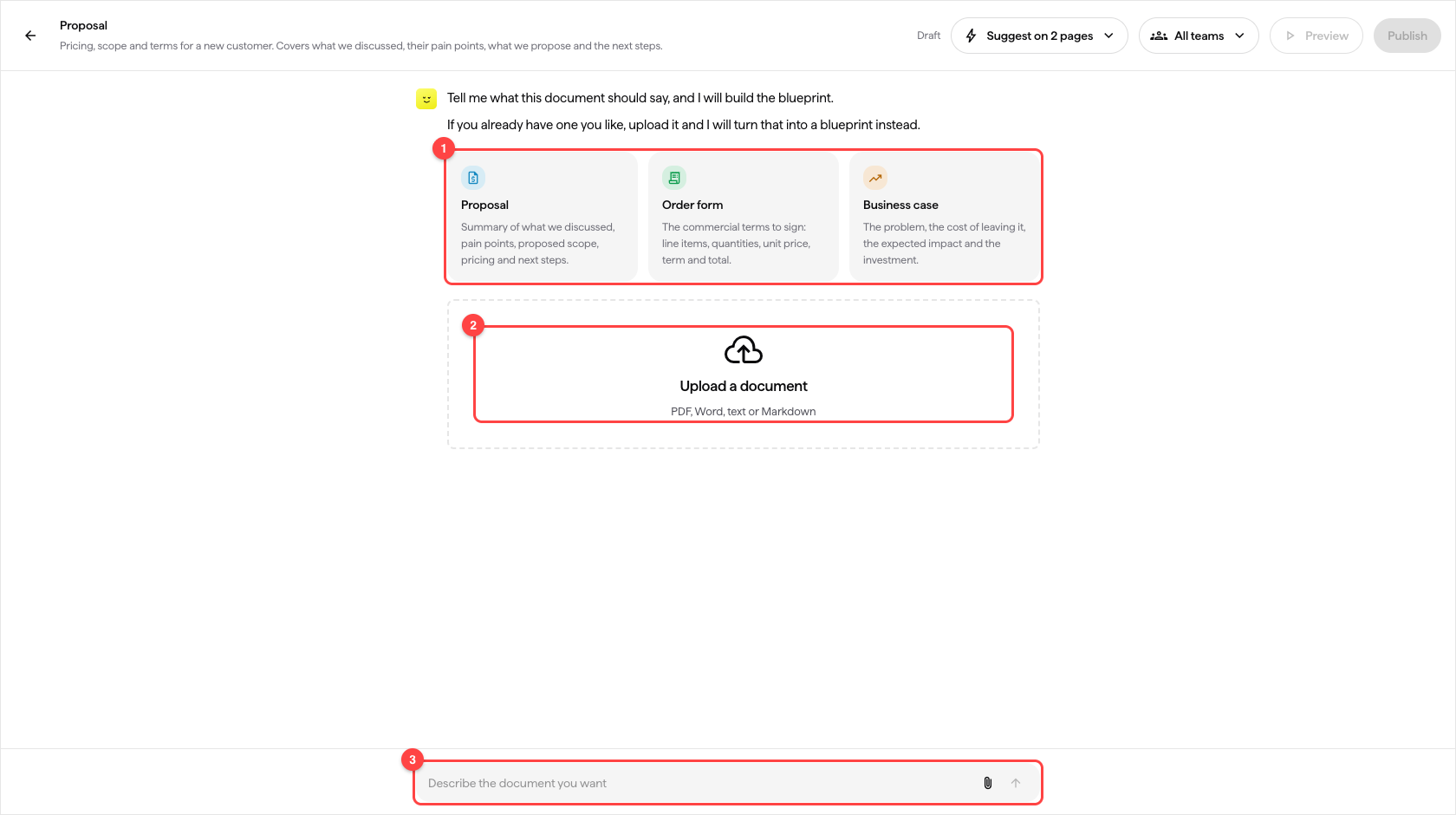
Starting points — one click builds a first draft. For a document: a proposal, an order form or a business case. For a site: a mutual action plan, an ROI calculator or a slide deck.
Upload a document — if you already have a proposal you like, drop the PDF, Word, text or Markdown file here and Garba turns that into a blueprint instead.
Or describe it yourself — "A proposal with a summary of what we discussed, their pain points, our scope, pricing and next steps."
Keep talking to the chat to change anything: "make the pricing a table", "add a section on security", "shorter intro".
Once the draft is there, the blueprint appears beside the chat.
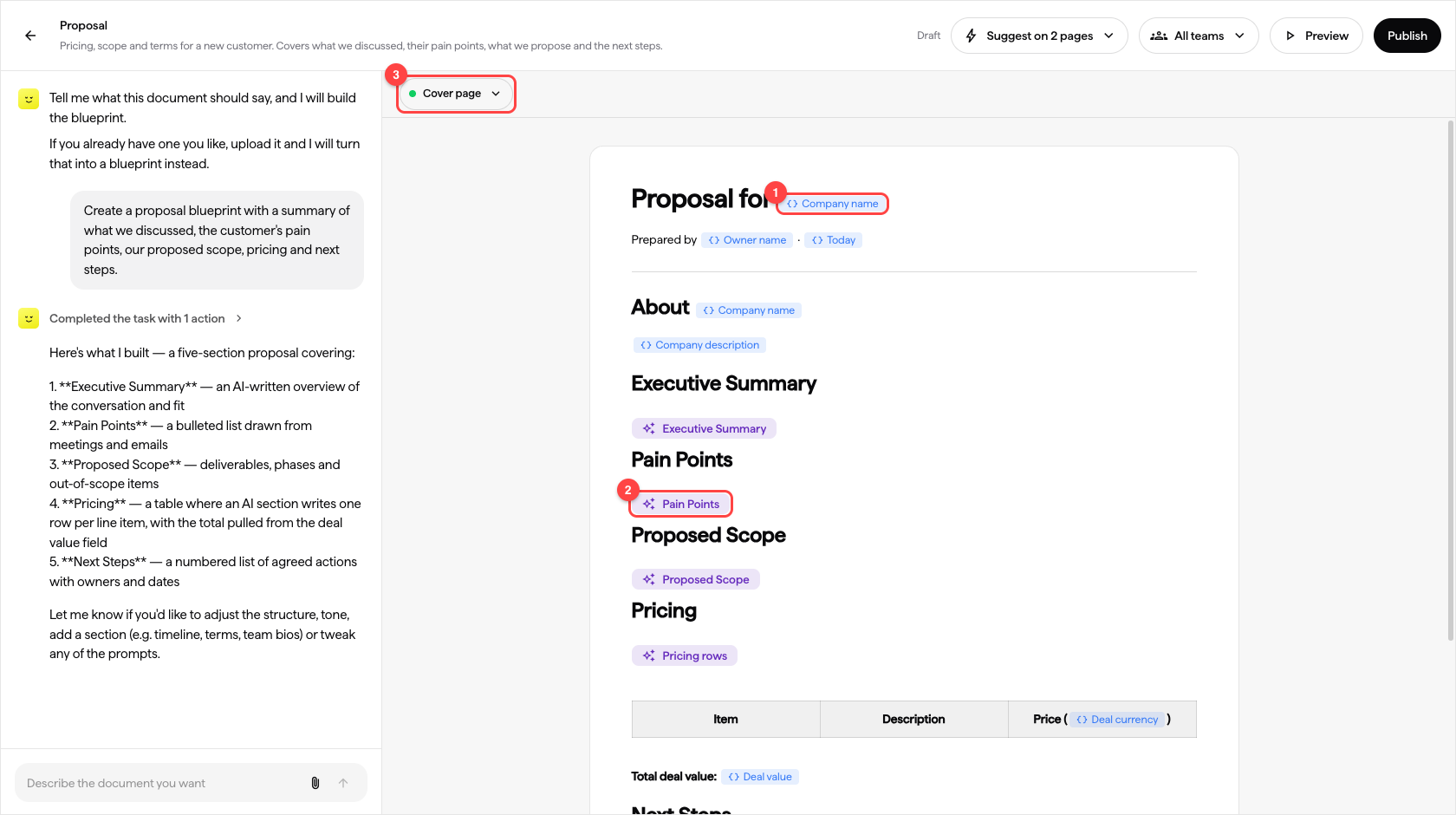
Blue placeholders — values Garba takes straight from your data: company name, industry, deal name, deal value, the owner's name, today's date. These are always correct, because they come from the record rather than from the model.
Purple placeholders — the parts Garba writes for each customer: a summary of your discussions, their pain points, a proposed scope, a pricing table.
Cover page — turn the cover page on or off, and choose what it shows (subtitle, date, company, logo).
Click any placeholder to change what it does.
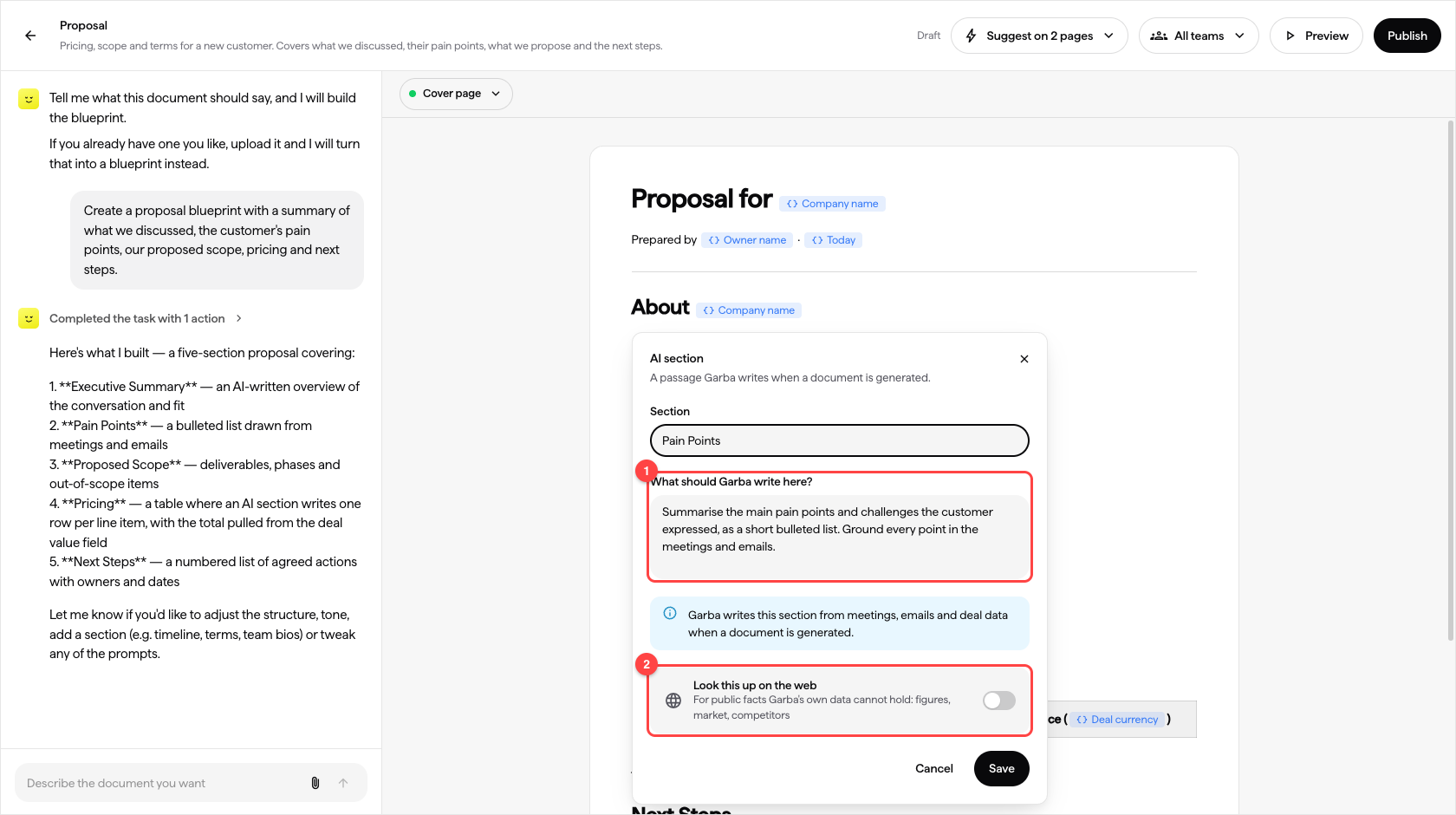
What should Garba write here? — the instruction for this placeholder. Edit it to change the wording, length or focus of what Garba writes.
Look this up on the web — off unless you turn it on, and you turn it on per placeholder. Use it for the public facts your own data cannot hold: a customer's published figures, their market, a competitor. One section can search the web while the rest of the document stays on your meetings, emails and CRM.
You can also edit the blueprint by hand — type, restyle, add rows to a table — and add a placeholder anywhere from the toolbar. Everything saves as you go.
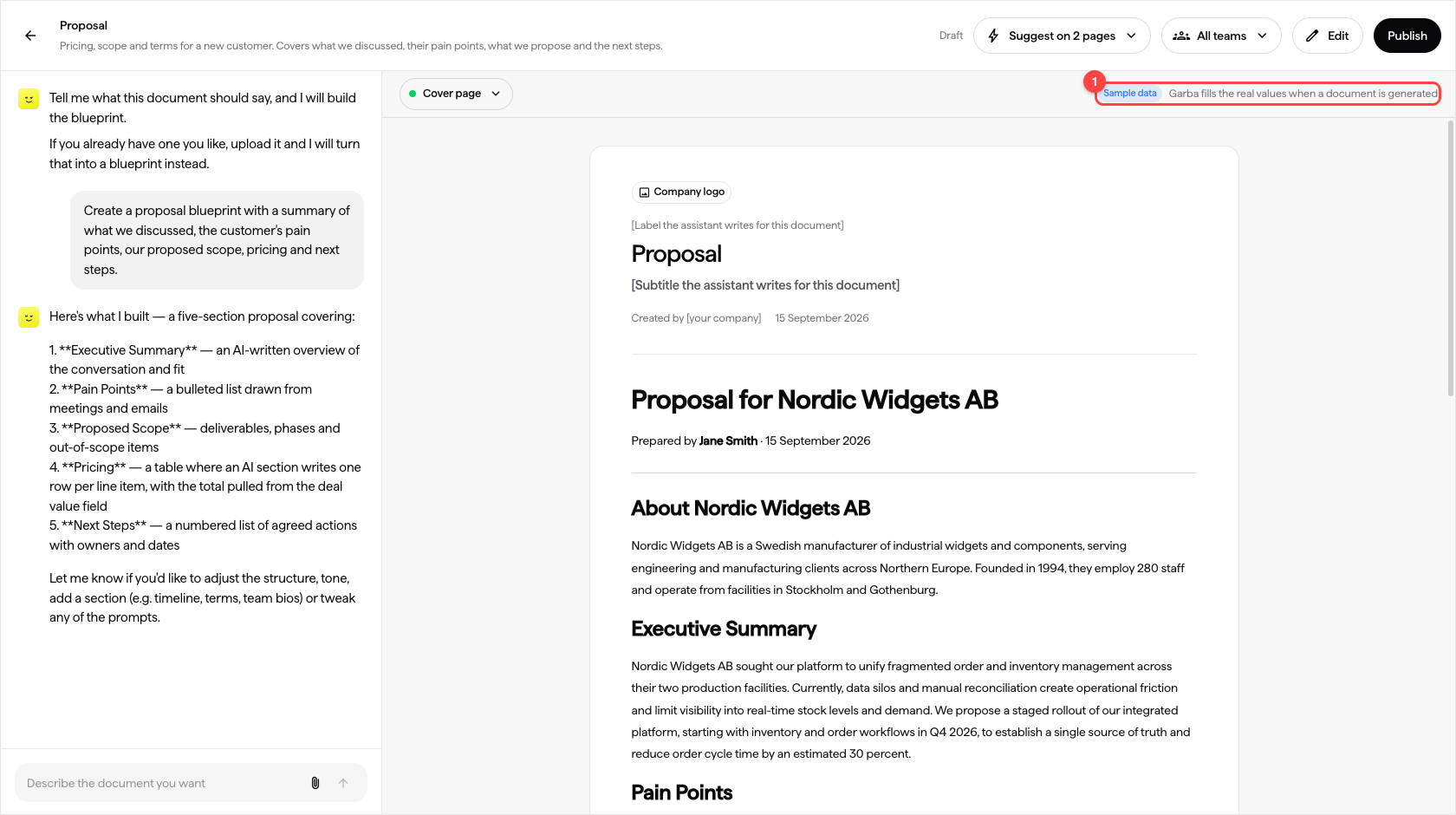
Sample data — Garba fills the whole blueprint with obviously made-up values so you can read it as a finished document. Nothing here comes from a real customer; the real values are filled in when someone generates a document.
Switch back with Edit and keep working until it reads the way you want.
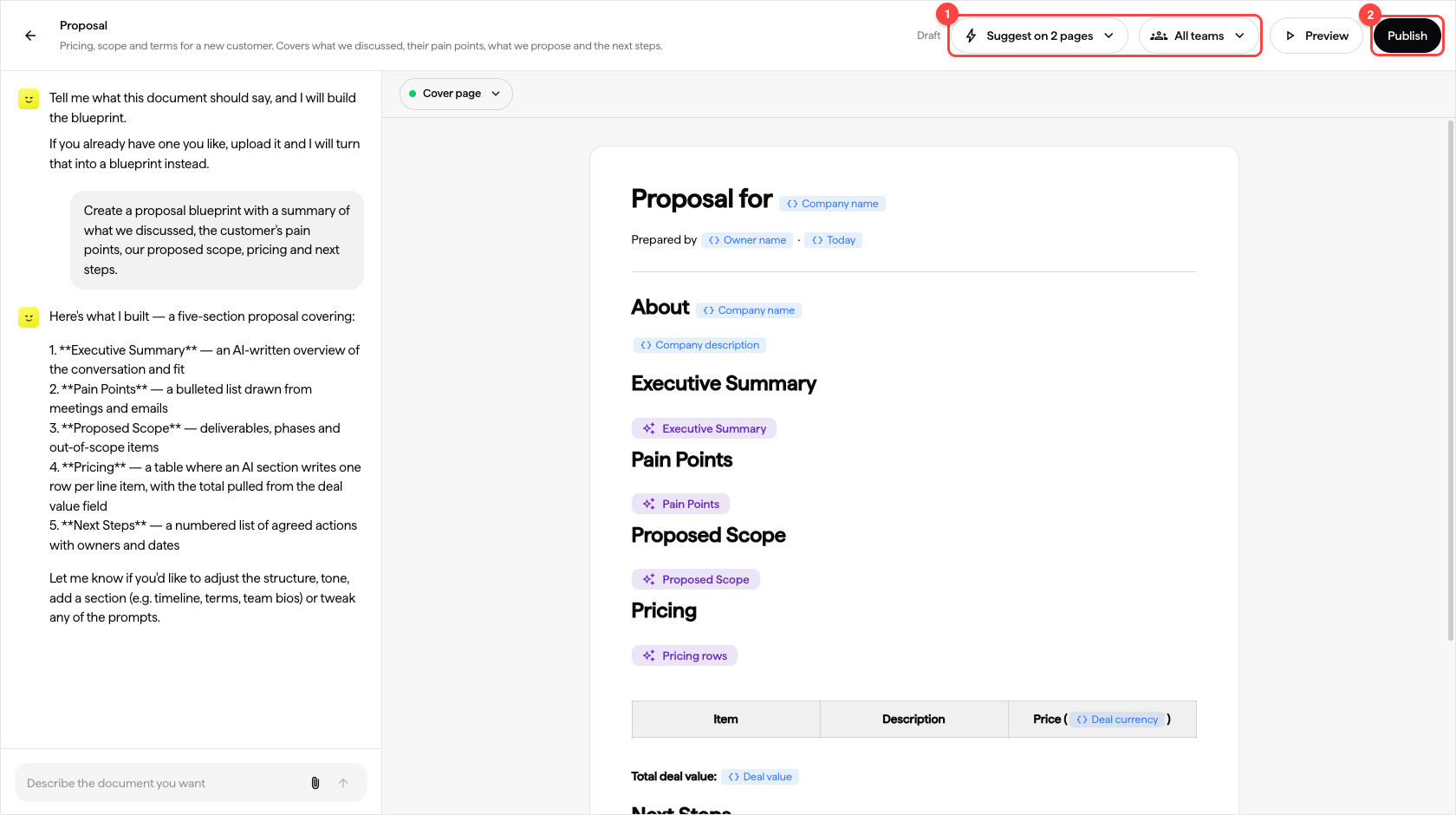
Suggest on and All teams — the same two settings as in the create dialog, kept in the toolbar so you can change them while you work.
Publish — until you publish, the blueprint is a draft and nobody can use it. It is not hidden, though: every admin who can open the Blueprints page sees the draft, not just whoever started it.
Editing a published blueprint does not affect your team until you publish again: your edits sit in a working copy, and a pill in the header counts how many unpublished changes you have. Open that pill to compare your working copy with what the team is using, or to discard your changes. The button then reads Publish changes.
Anyone with Ask Garba can use a published blueprint. On a deal, company or meeting page, the blueprints you chose to suggest appear as tiles under the Ask Garba box.
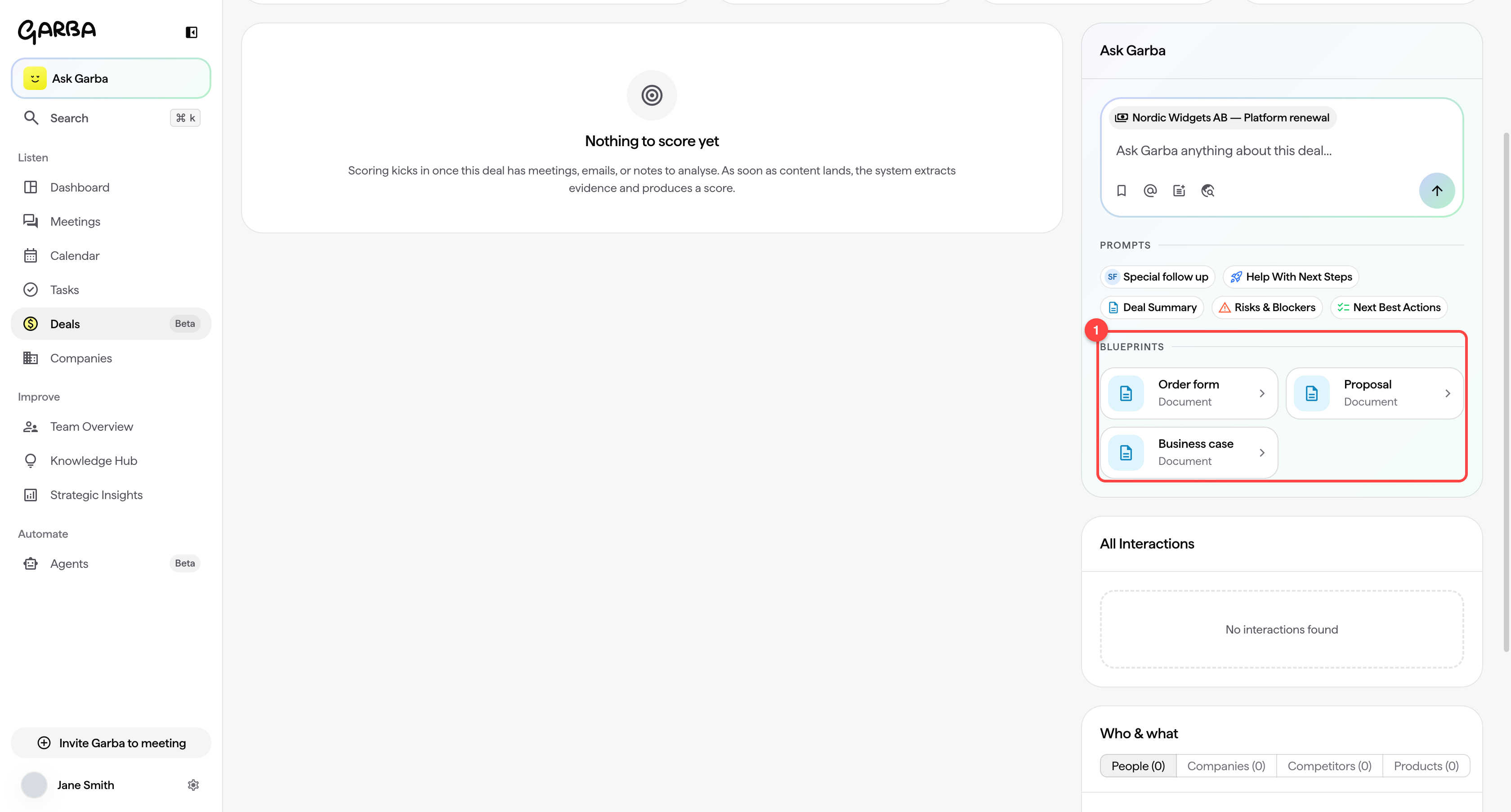
Blueprints — one click asks Garba to fill that blueprint for the deal, company or meeting you are looking at.
You can also just ask: "Draft a proposal for Nordic Widgets using our proposal blueprint." Garba picks the blueprint by name, gathers what it needs from your meetings, emails and CRM data, and writes the document.
Or pick one from the Ask Garba box itself: the Blueprints button beside the input lists every published blueprint you can use, grouped into Documents and Pages, wherever you are in Garba. Choosing one writes the request for you, so you only add which deal or company it is for.
A blueprint that uses deal or company fields needs one to fill in. If it is not obvious which deal you mean, Garba asks.
The result is an ordinary Garba document, yours to edit.
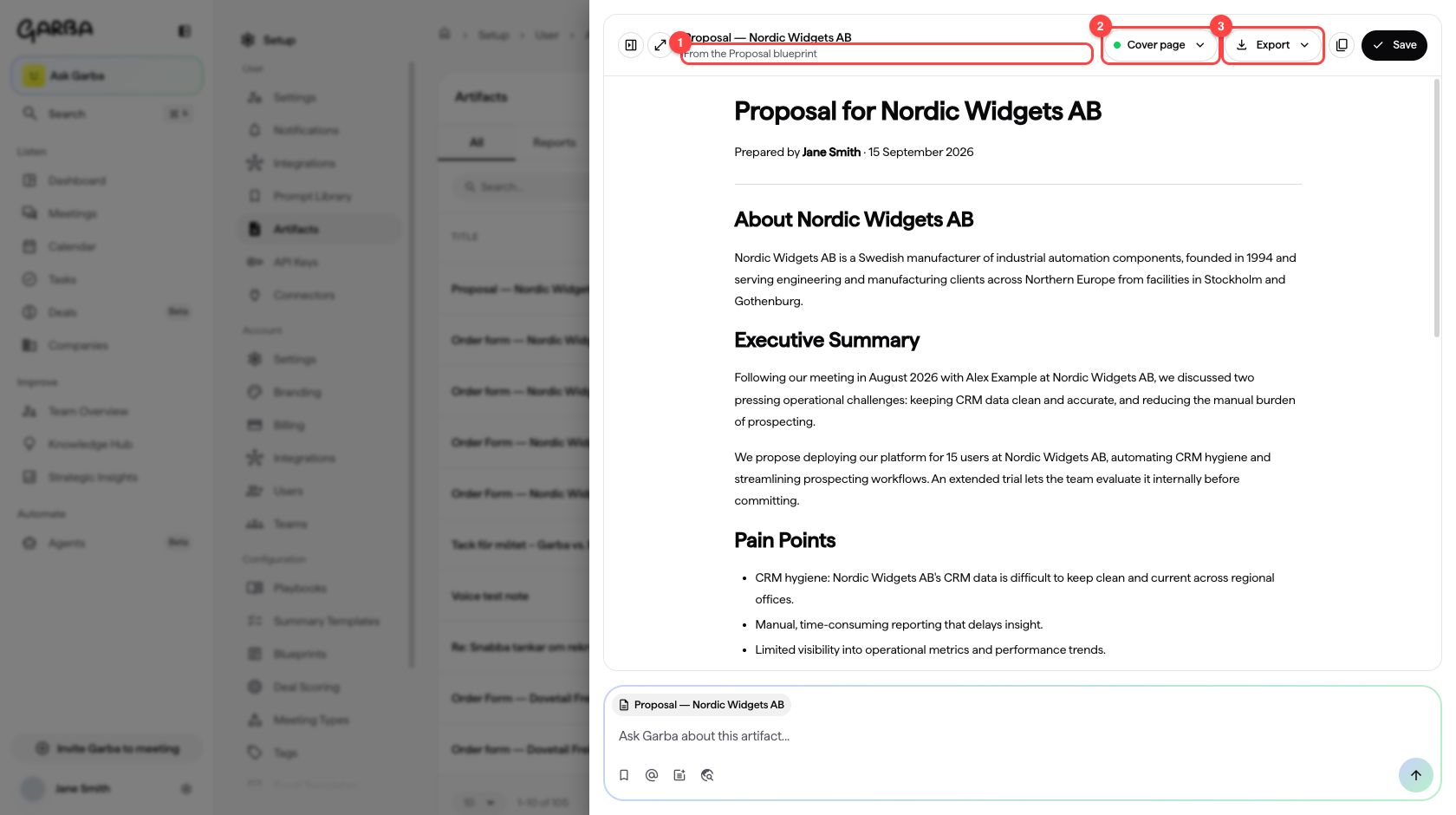
From the … blueprint — every generated document says which blueprint it came from.
Cover page — the cover settings come from the blueprint; you can still change them here.
Export — download as PDF or Word, or send it by email. Sites get a share link instead, with an optional password and expiry.
Edit anything you like before you send it: the document is a normal artifact, with version history and an Ask Garba box of its own.
A site blueprint is a whole web page rather than a document, so its editor looks a little different.
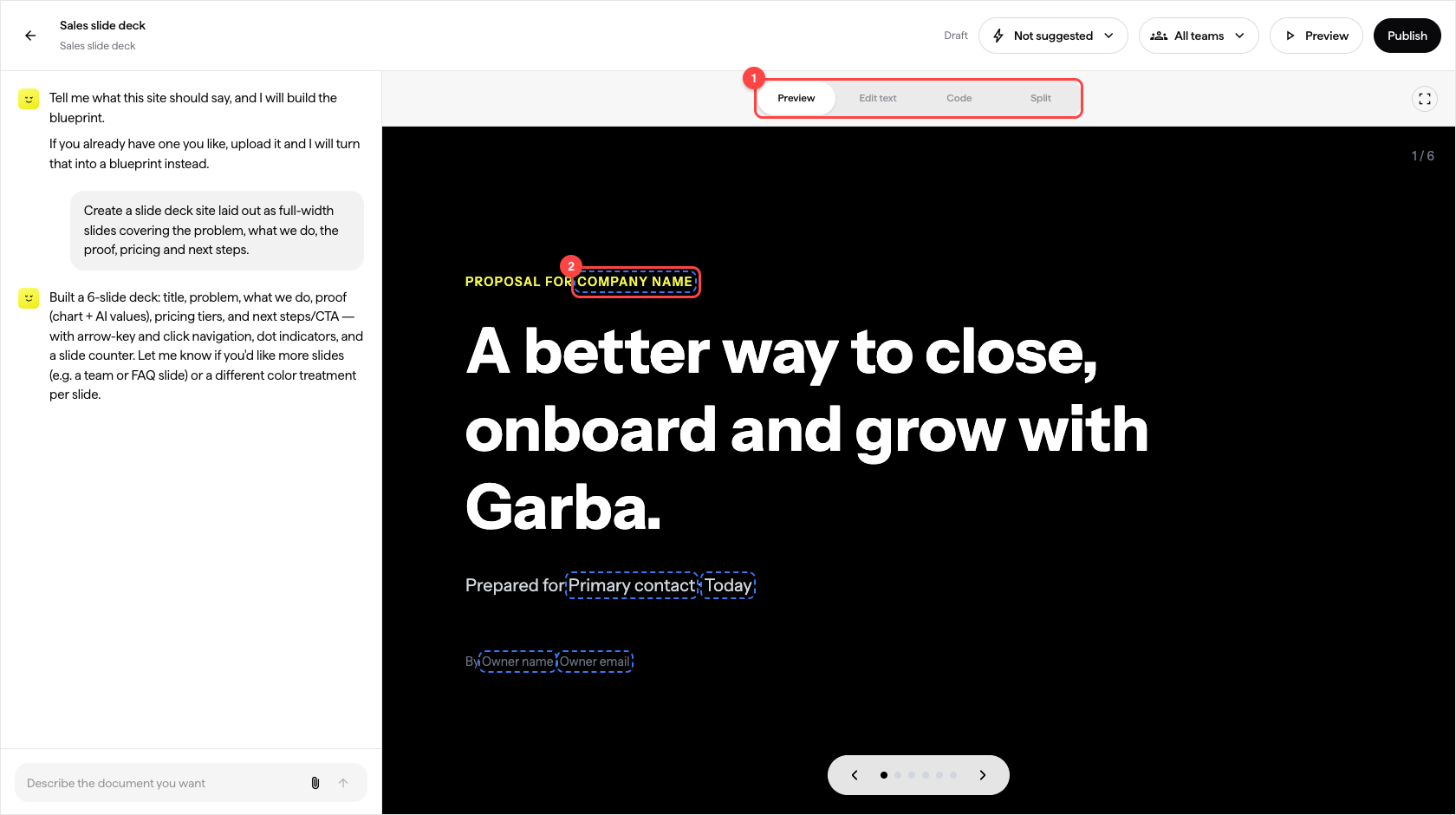
Preview / Edit text / Code / Split — see the page as the customer will, retype the page's own wording in place, edit the HTML directly, or view page and code side by side. Edit text is how you reword a site blueprint without touching HTML: click any of the page's own words and type over them, and the layout and styling stay exactly as they are.
Placeholders in the page — the same blue and purple kinds as in a document, outlined where they sit. Click any one to change its label, its instruction, or whether it looks its answer up on the web.
Site blueprints can hold anything a web page can: charts, a sticky in-page menu, even an ROI calculator the buyer adjusts themselves. The filled page is shared as a link.
Only admins can create and edit blueprints. Everyone with Ask Garba can use the published ones.
Deleting a blueprint keeps the documents made from it.
Blue placeholders never guess. If a value is missing from your data, Garba says so rather than inventing one — usually a sign the CRM field is empty.
The description matters. It is how Garba decides which blueprint someone means, so write it for a colleague who has never seen it.
